Interactive examples
Working Arian University lesson
One motor lesson students can watch, annotate, and explore.
This industrial-electricity demonstration connects motor construction, induction, slip, torque, wiring, and lab practice inside one coordinated teaching experience.
An available-now lesson and delivery demonstration. Learning-impact measures can be defined in a course pilot.
Lesson production evidence
- 9lesson sections
- From motor anatomy to lab practice
- 8:34prepared narration
- Condensed media within a longer teaching and lab plan
- 56timed teaching cues
- Focus shifts follow the explanation
- 4available-now modes
- Prepared playback, ink, local notes, and visual live-follow
The teaching challenge
Make an invisible process easier to follow.
An induction motor hides its most important relationships inside the machine. Students need to connect physical parts, electromagnetic cause and effect, operating equations, wiring, and lab observations without losing the larger picture.
- 01
See the machine
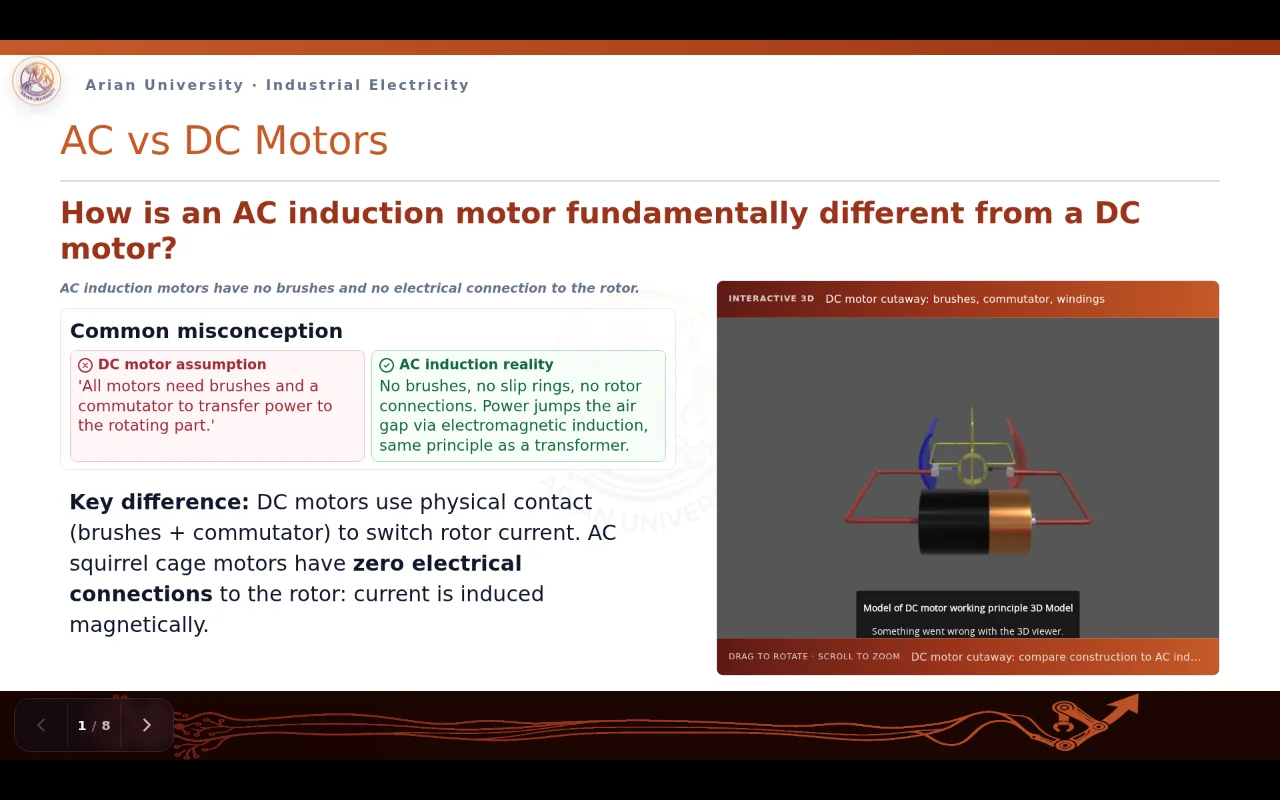
Compare AC and DC motors, then identify the stator, rotor, end rings, shaft, bearings, cooling system, and terminal box.
- 02
Follow cause and effect
Connect three-phase current, the rotating magnetic field, induced rotor current, and torque as one visible sequence.
- 03
Connect the equations
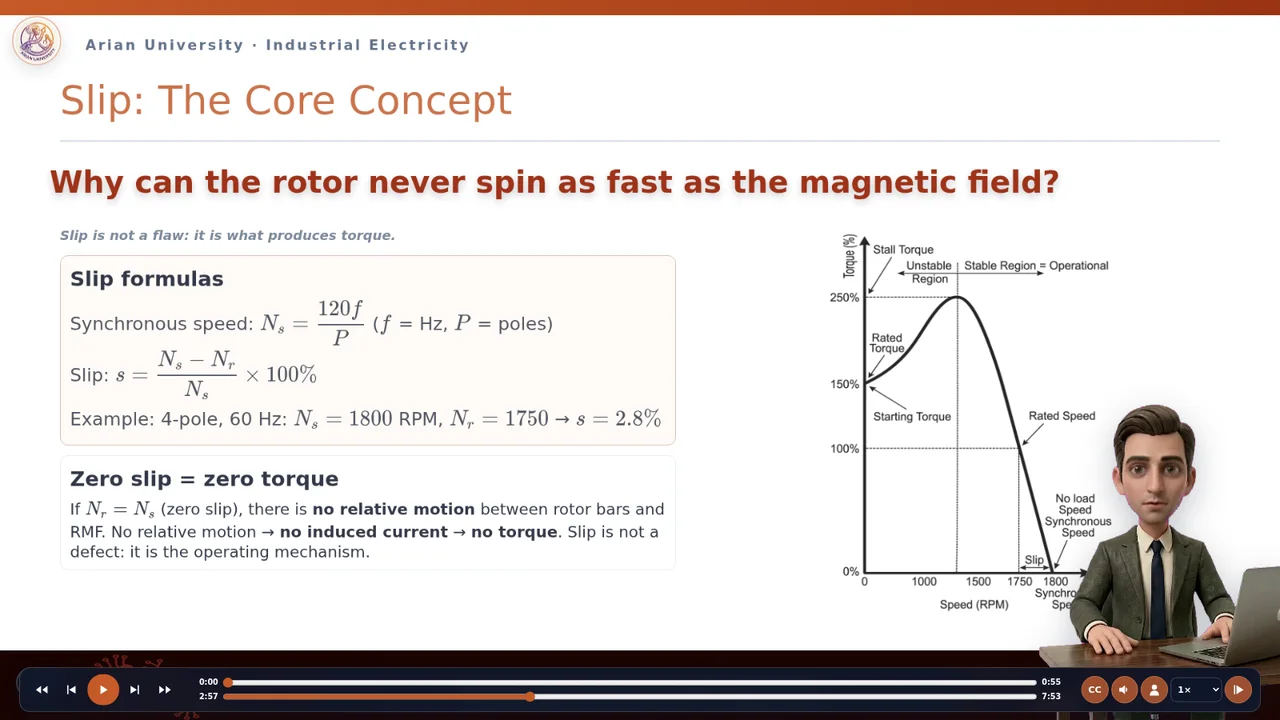
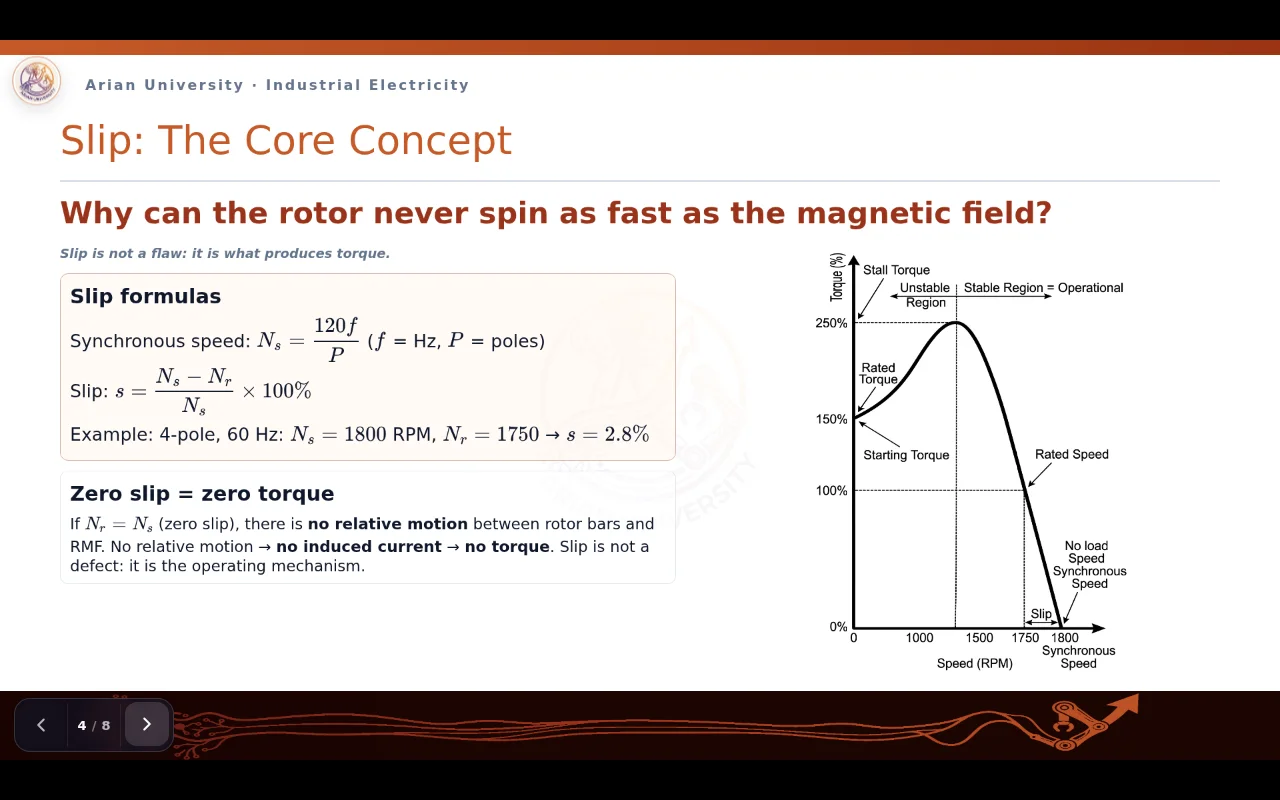
Relate synchronous speed and slip to load, rotor speed, torque, and the operating behaviour students observe.
- 04
Move into practice
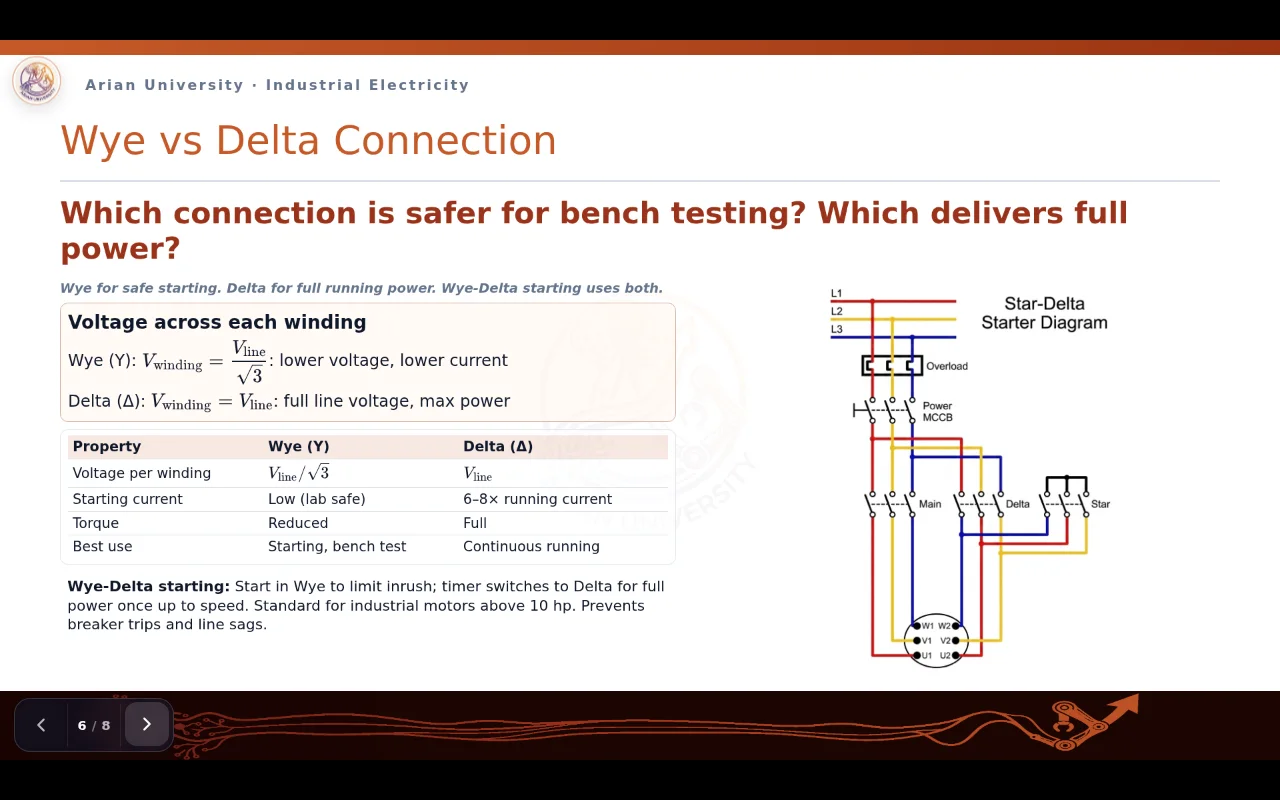
Finish with Wye and Delta connections, measurement ideas, lab experiments, formulas, and practical takeaways.
Inside the lesson
The sequence moves from construction to equation to practice.
Each section answers one focused question, while the complete sequence keeps motor parts, electromagnetic behaviour, formulas, wiring, and lab work connected.
More than a slide deck
Four layers produce one reviewable lesson.
Content, narration, timeline, and delivery remain separate enough to review and update, while the player presents them as one coherent experience.
Structured lesson
Available now in this demonstration: reviewable slide data combines text, formulas, visuals, and sequence. A source-grounded production workflow is in development.
Narrated media
Available now in this demonstration: each section has prepared narration, captions, and a transparent presenter layer.
Teaching timeline
Available now: semantic cues coordinate focus, reveals, captions, media, and the on-screen presenter.
Reusable player
Available now: the lesson supports prepared playback, annotation, local notes, visual live-follow, browser links, and permitted embeds. Secure LMS identity and production live audio require an institutional pilot.
Try the working lesson
Choose how you want to experience it.
The poster loads first. The full lesson player and media load only after you request the interactive demonstration.
Open the full lesson Available now · Prepared lesson playback
Slides, narration, captions, and an on-screen presenter stay synchronized.
Students can pause, change speed, revisit a slide, or seek through the prepared lesson. Additional approved avatar and voice production options are in development.From demonstration to pilot
A course pilot can add agreed learning measures.
The demonstration proves the lesson-production and delivery path. A partner pilot can then evaluate the teaching experience against goals selected by the instructor and institution.
- Concept checks before and after the lesson
- Student ability to explain slip and torque
- Instructor workflow during explanation and annotation
- Accessibility, device, and LMS delivery feedback
Your difficult concept
Build the next case study around a real course need.
Bring one topic, the teaching goal, and the source material you trust. We can define a focused lesson and a reviewable pilot path.